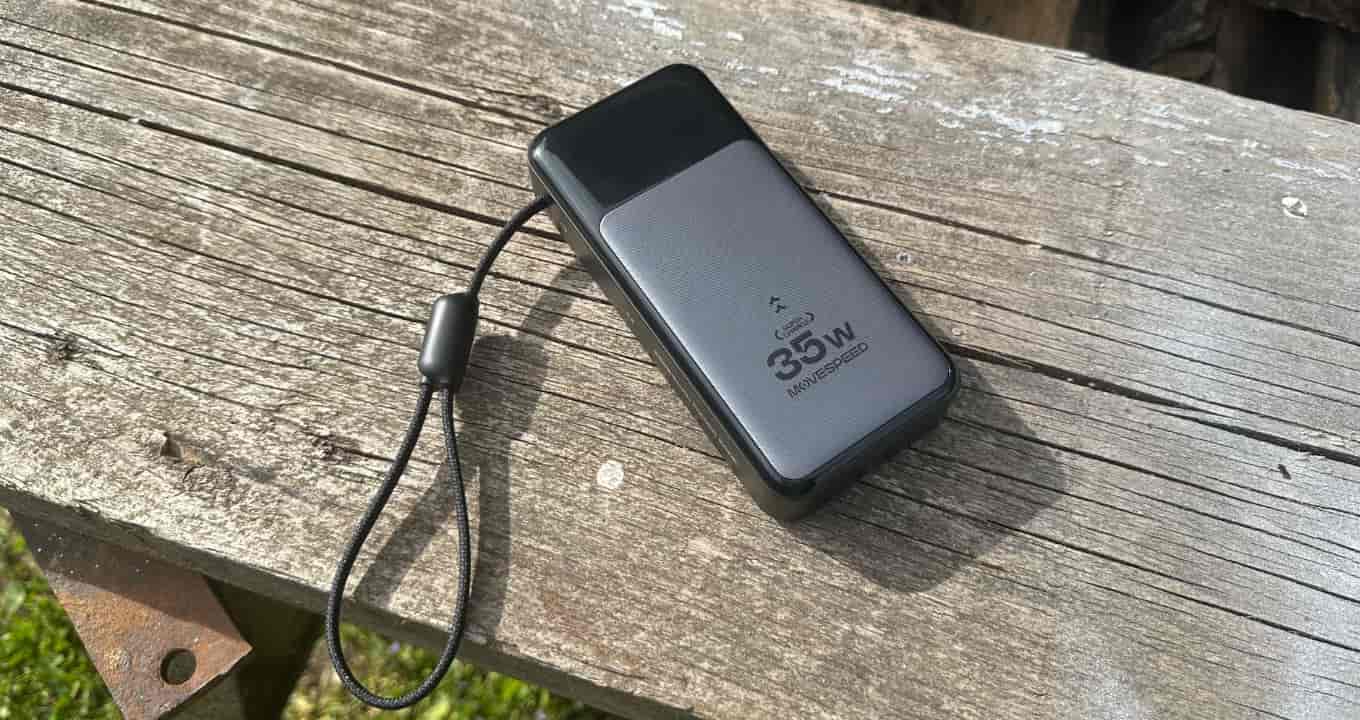
Most power banks on the market recycle the same old formula: NMC cells, a handful of ports, and a plastic shell. The MOVESPEED MSP20 — also sold as the MOVESPEED P20 — takes a different approach. It pairs a 20,000 mAh LiFePO4 (LFP) battery with an integrated USB-C cable and up to 35 W of output, all wrapped in a sturdy polycarbonate body. We put it through its paces to find out whether the hardware lives up to the marketing.
What’s in the Box
Don’t expect accessories: the MSP20 ships with only the unit itself and a brief instruction leaflet. No charging cable is included — but that’s intentional, given that the built-in USB-C cord is the device’s star feature. First impressions are positive. The housing measures 147.6 × 69 × 30 mm and sits comfortably in the hand, with well-finished plastic that has no sharp edges or obvious gaps. That said, at approximately 418 grams it is noticeably heavier than many NMC rivals — a direct consequence of the LFP chemistry inside.
Build Quality & Industrial Design
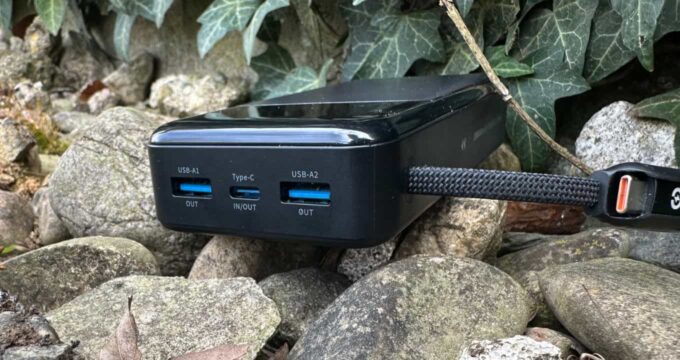
The MSP20 adopts a clean, no-frills aesthetic. The small digital display sits on the front face, while all ports are grouped neatly along the bottom edge. The integrated USB-C cable is roughly 30 cm long and tucks away securely — a genuine convenience bonus for commuters who would rather not carry a separate cable.
There is also a clever secondary use for that cable: thanks to its flexibility, it can loop through a carabiner or around a finger, turning the power bank into a carry-friendly pendant. Fingerprints do accumulate on the matte housing, and the 30 mm thickness may disappoint anyone expecting a thin slab. Both are unavoidable trade-offs for the two LFP pouch cells packed inside.
The Display: Useful, With One Caveat
A percentage-based digital readout is a meaningful upgrade over the LED dot indicators found on budget rivals. When charging, a green arc and power symbol animate on screen — a small but satisfying touch.
Between 15% and 100%, accuracy is genuinely impressive; the displayed figure closely matches the watt-hours actually drawn, suggesting the manufacturer uses shunt-based or equivalently precise current sensing. The one weakness: outdoor readability. In direct sunlight the display is almost invisible. In low-light conditions it performs well. This looks like a deliberate trade-off to reduce parasitic drain, but users who frequently use the bank outside in bright conditions should be aware.
Technical Specifications
- Model: MSP20 / P20
- Cell chemistry: LFP / LiFePO4 (pouch)
- Rated capacity: 20,000 mAh / 6.4 V / 64 Wh (2 × 10,000 mAh @ 3.2 V)
- Nominal output capacity: 10,000 mAh (5 V = 3 A)
- USB-C port output: 5 V/3 A · 9 V/3 A · 12 V/2.92 A · 15 V/2.33 A · 20 V/1.75 A
- USB-A1/A2 output: 5 V/3 A · 9 V/2 A · 10 V/2.25 A · 12 V/1.5 A
- Max. single-port output: 35 W (integrated cable & USB-C port)
- Max. USB-A output: 22.5 W
- Charging protocols: PD 3.0 · PPS · QC 3.0
- Dimensions: 147.6 x 69 x 30 mm
- Weight: ~418 g
- Certifications: CE · FCC · GB 31241-2022 · GB 4943.1-2022
Is the LFP Claim Genuine?
The packaging and device label only say “Li-Polymer,” which understandably raises eyebrows. MOVESPEED explains on the AliExpress product page that “Li-Polymer” is the official 3C-certification term for pouch-format cells, regardless of whether the internal chemistry is NMC or LFP.
The voltage spec is the smoking gun here: the label states 6.4 V / 64 Wh for 20,000 mAh, which maps precisely to two LFP cells in series, each with a nominal cell voltage of 3.2 V. Standard NMC cells run at 3.6–3.7 V per cell, so the numbers simply would not add up if NMC were used. Weight also corroborates this: LFP carries a roughly 30% mass penalty versus NMC at equivalent capacity, and 418 g is entirely consistent with two 10,000 mAh LFP pouch cells plus housing, electronics, and the integrated cable. Therefore the LFP claim holds up.
Outputs & Charging Performance
All four output channels — the integrated USB-C cable, the USB-C port, and two USB-A ports — hit their rated values reliably in testing. Voltage stability under load was solid throughout normal operation. One exception: below roughly 10% state of charge, sustaining a full 35 W (20 V / 1.75 A) output becomes unreliable because the cell voltage is simply too low to support the converter. At 15 W the bank still delivers cleanly even at low charge levels.
Heat: The Achilles’ Heel
This is where the MSP20’s biggest limitation surfaces. Running a sustained draw of approximately 30 W or more through the USB-C interface, the bank overheated and cut charging after roughly 7 minutes at room temperature in our tests. Thermal imaging showed temperatures exceeding 70 °C at the USB ports — a value that points to insufficient heat dissipation inside the compact plastic enclosure. The display side of the housing reached around 50 °C simultaneously.
In practical terms: if you want to top up a laptop or tablet that consistently pulls 30 W+ over an extended session, expect interruptions. You will need to let the unit cool before charging resumes.
The story is far better at lower loads. With a steady 10 W draw (5 V / 2 A — typical smartphone territory), the bank stayed barely warm, with the port area measured at ~36 °C and the top surface at under 31 °C. For phones, earbuds, smartwatches, and similarly modest consumers, the MSP20 is perfectly comfortable.

Real-World Capacity
MOVESPEED’s rated 64 Wh is a best-case ceiling, not a guarantee; DC/DC conversion losses and an internal low-voltage cell guard always reduce usable output.
- Heavy load (~30 W continuous): 50 Wh ~78%
- Light load (10 W continuous): 54 Wh ~84%
These figures trail comparably specced NMC banks by a few percentage points (most achieve 85–90% efficiency). The gap is not a quality failure; it reflects a deliberate design choice to protect the LFP cells from deep discharge by reserving an internal buffer — even when the display reads “0%.” Long term, this buffer is precisely what enables the cell longevity LFP is known for.
Charging the Bank Itself
Replenishing the MSP20 works via either the USB-C port or the integrated cable, both accepting up to 30 W (20 V / 1.5 A). With a capable PD charger in hand, a full charge takes roughly three hours — reasonable for a 64 Wh pack. Crucially, you can charge through the built-in cable without hunting for an extra cord, which is a minor but appreciated quality-of-life detail.
Verdict
The MOVESPEED P20 / MSP20 is a compelling option for anyone who values battery longevity, reduced fire risk, and the simplicity of a built-in cable over raw performance metrics. Its LFP cells, verified by both voltage specification and weight analysis, bring genuine safety and cycle-life advantages to the table — typically 2,000+ cycles versus 300–500 for most NMC banks.
Strengths:
- Verified LFP chemistry: higher safety, longer lifespan, better thermal stability
- Integrated 35 W USB-C cable — no loose cables to carry
- Cable doubles as a practical carry loop
- Accurate state-of-charge readout from 15–100%
- All four output ports meet rated specifications
- Solid, well-finished housing
Weaknesses:
- Thermal throttling kicks in after ~7 minutes at loads above 30 W
- Display washes out in direct sunlight
- Marginally lower efficiency than comparable NMC alternatives
Bottom line: The MSP20 is an ideal everyday carry for phones and small gadgets, and a sensible pick for safety-conscious users who prioritise longevity. If your primary use case involves sustained high-wattage laptop charging, the thermal limitation is a genuine concern worth factoring into your buying decision.
This article was created in cooperation with the German tech news portal Xgadget.de.
Comments